Ransomware-Resistant Backups: The Critical Features Your Organization Needs in 2026
Jennifer Giraldo
Invarosoft Team
Ransomware is one of the biggest threats facing organizations today. Recent cybersecurity reports claim that the average cost of ransomware attacks in 2024 exceeded $4.5 million globally, with recovery times often stretching over three weeks. In the United States alone, ransomware attacks increased by 28% year-on-year, affecting businesses of all sizes.
Here's the truth no one wants to talk about: it's no longer a question of if your organization will face a ransomware attack, but when. The good news? With the right backup strategy and proactive monitoring, your organization can be ready to recover quickly if an attack occurs.
#1: Immutability and Air-Gapped Storage
The most important feature ransomware-resistant software needs is the ability to create backups that cannot be altered, encrypted, or deleted by anyone — including administrators — for a specified period.
Immutable backups operate on a "write once, read many" (WORM) principle. Once written, the data becomes locked for a period of time. Even if ransomware compromises your entire network with administrative privileges, it cannot modify these immutable backup copies.
Leading organizations in 2026 implement a 3-2-1-1 backup strategy:
- 3 copies of data
- 2 different media types
- 1 copy off-site
- 1 copy offline or air-gapped
#2: Comprehensive Backup Monitoring Software
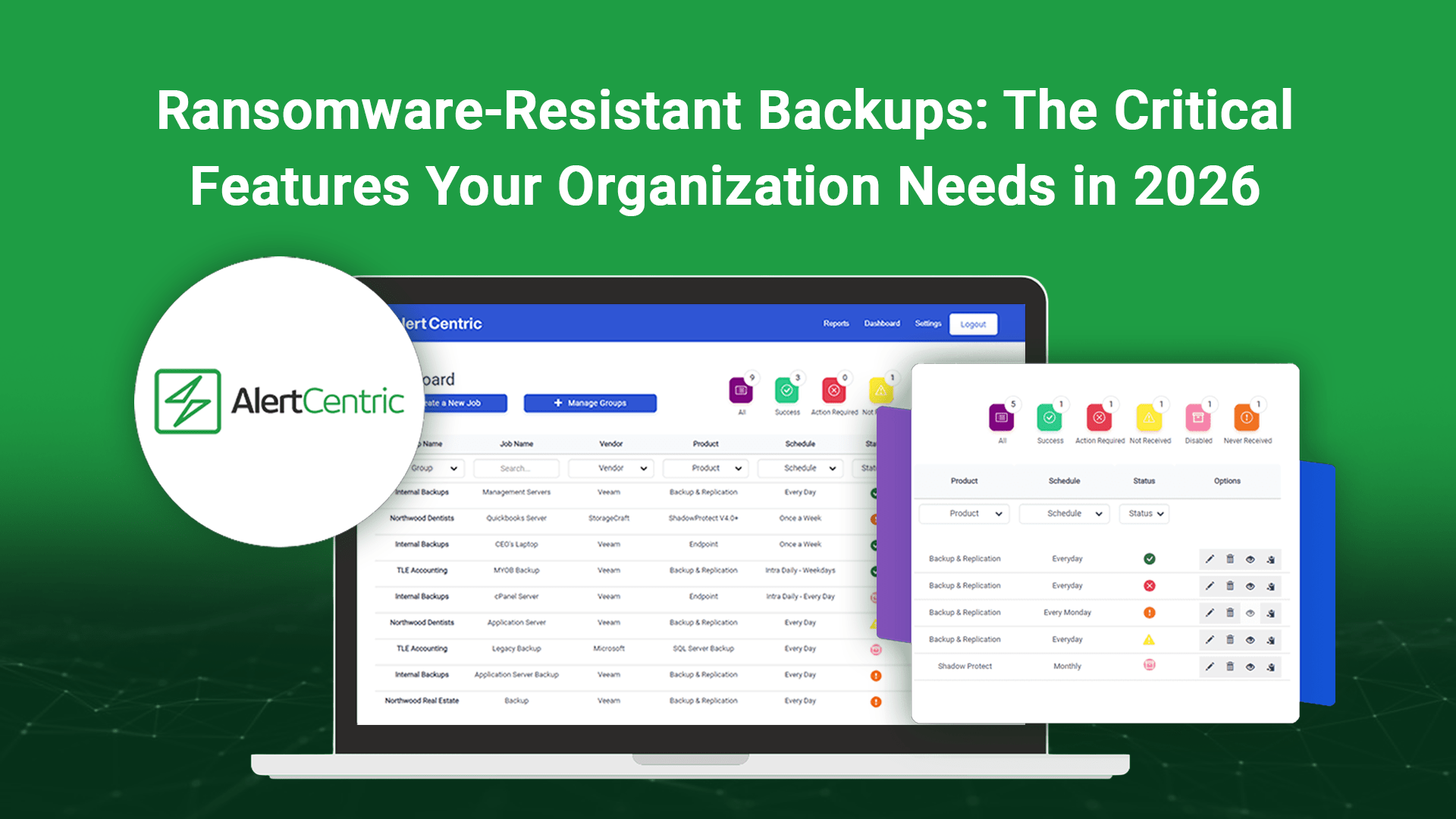
Creating backups is only half the solution. Without proper monitoring, you might discover your backups have failed only when you desperately need them. Effective backup monitoring solutions provide:
- Real-time alerting — immediate notification of backup failures, anomalies, or security incidents
- Success verification — automated validation that backups completed successfully and data is recoverable
- Trend analysis — identification of patterns that might indicate compromised systems or growing data volumes
- Multi-vendor support — unified monitoring across diverse backup platforms and environments
- Compliance reporting — documentation proving adherence to regulatory backup requirements
#3: Automated Recovery Testing
Here's a sobering statistic: approximately 30% of organizations that test their backup recovery processes discover their backups are corrupted, incomplete, or otherwise unrecoverable. Imagine discovering this during an actual ransomware incident.
Ransomware-resistant backup strategies must include automated, regular recovery testing. This means:
- Periodically restoring data to isolated environments
- Validating data integrity and completeness
- Documenting recovery time objectives (RTOs) with actual measured performance
- Testing recovery procedures across different failure scenarios
Modern backup monitoring software can automate much of this testing, providing regular validation that your backups will perform when needed — identifying issues during calm periods rather than during crisis situations.
#4: Zero-Trust Security Architecture
The traditional security perimeter has dissolved. Remote work, cloud services, and increasingly sophisticated attack vectors mean that trusting anything inside your network by default is no longer viable.
Zero-trust principles applied to backup infrastructure mean:
- Every backup operation requires explicit verification
- Access is granted based on least-privilege principles
- All backup activities are logged and auditable
- Backup credentials are isolated from production credentials
Bringing It Together: A Layered Defense
No single feature makes a backup system truly ransomware-resistant. The organizations that recover quickly from ransomware attacks are those that implement a layered approach — immutable storage, continuous monitoring, automated testing, and zero-trust architecture working together as a cohesive strategy.
For MSPs, the message is clear: your clients need more than backups that appear to run successfully. They need a validated, monitored, and tested backup strategy that will actually deliver when the worst happens. The MSPs who can demonstrate this rigorously are the ones who win and keep enterprise-grade clients.